My brother slapped my 2-year-old daughter in front of nearly twenty family members and coldly said, “Maybe now she’ll learn.” My parents defended him, but I didn’t fight with them. I took my daughter to the hospital, saved every message, and recorded everything. Then I played one piece of evidence that forced everyone to face the truth they had spent years hiding…
PART 1
“Let’s see if that spoiled little brat finally learns her lesson!”
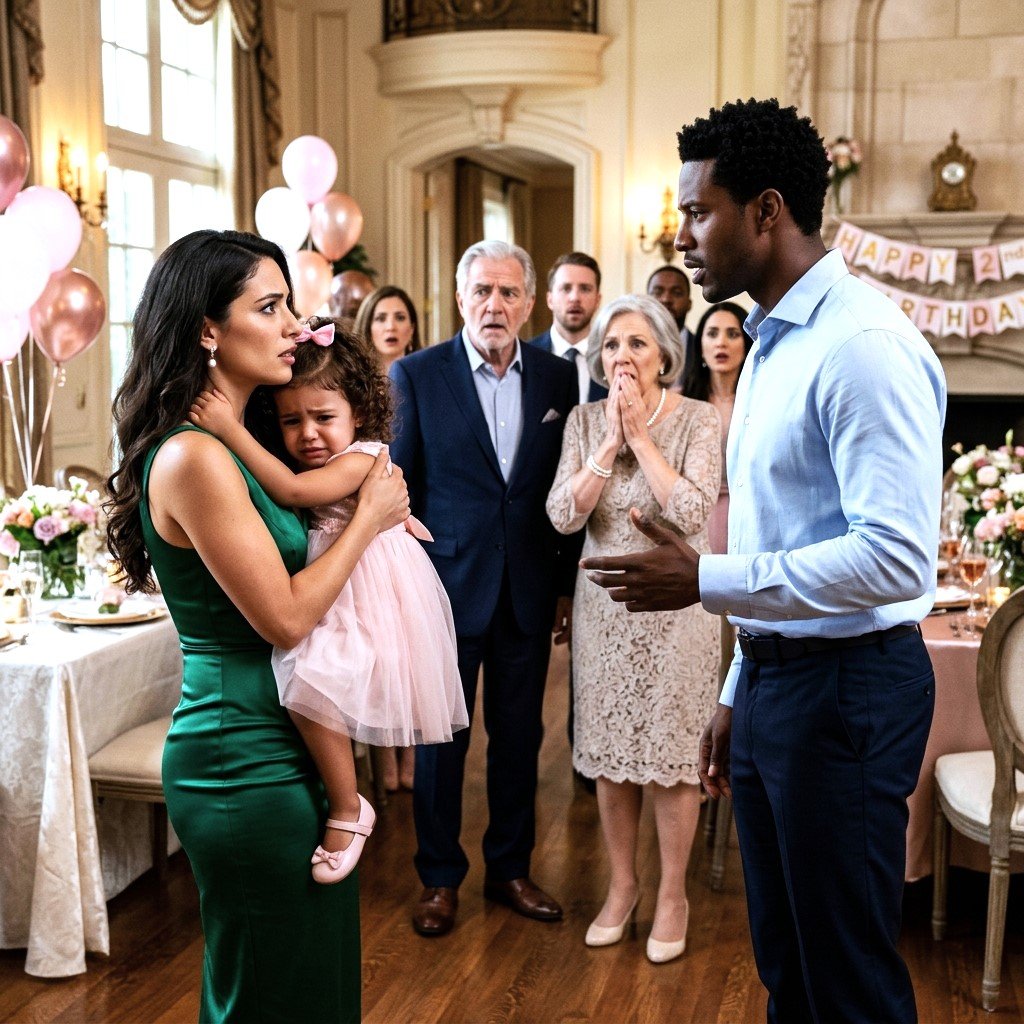
The sharp sound of the slap cut through the loud music, laughter, and clinking glasses.
My two-year-old daughter, Maisie, had reached toward the sparkling ribbons decorating the centerpiece when my older brother, Gavin, struck her across the face.
Her head jerked to the side.
For one horrible second, she stood completely still.
Then she began to cry.
That terrified cry still wakes me up at night.
I rushed across my parents’ living room and pulled her into my arms.
“What the hell did you just do?” I demanded, holding her tightly against my chest.
Gavin calmly lowered his hand and looked at me as if I were the one causing a problem.
“I was correcting her because you never set any boundaries,” he said.
“She is two years old!” I shouted.
“Exactly. If you don’t teach her now, she’ll be even worse when she gets older.”
Before I could respond, my mother, Trinity, hurried over.
“Gemma, stop yelling! You’re ruining Luke’s birthday party.”
I stared at her in disbelief.
“He just hit my daughter in front of everyone!”
“It wasn’t a real hit,” my mother said dismissively. “It was just a light slap.”
My father, Donald, folded his arms.
“You’re partly responsible too. You let her run around this house like it’s a playground.”
Maisie buried her face in my neck. Her entire little body was trembling, and her sobs felt like they were tearing straight through my chest.
Gavin, meanwhile, looked completely relaxed.
He opened another beer, leaned against the bar, and gave a small smile.
“Someone had to teach her some manners.”
I looked at the red mark beginning to form on my daughter’s cheek.
And suddenly, I understood something I had spent years refusing to admit.
In my family, protecting Gavin had always mattered more than protecting everyone else.
I grabbed Maisie’s blanket, her backpack, and my car keys.
“Are you seriously leaving over this ridiculous nonsense?” my mother yelled as I headed toward the door.
I stopped and looked back at them.
“No,” I said quietly. “I’m leaving because I finally understand everything.”
Outside, I buckled Maisie into her car seat and started the engine.
The moment I drove away, my phone began vibrating constantly.
My mother texted that I was overreacting.
Another message said I had ruined the party.
My father wrote that Gavin had only been trying to help me and that I needed to come back and act like an adult.
I didn’t answer anyone.
Instead, I created a new folder on my phone and began saving every message.
I drove straight to Lakeside General Hospital.
During the drive, Maisie didn’t point at dogs, balloons, or anything else she usually noticed.
She simply held her stuffed rabbit tightly, its ears bent down, and stayed silent.
At the hospital, the doctor carefully examined her face, eyes, and reflexes.
“The mark should fade,” he told me, “but I’m going to document everything in her medical record. Can you tell me exactly what happened?”
I felt the familiar urge to soften the truth.
I wanted to say it was an accident.
I wanted to say Gavin had lost control for only a second.
But then I looked at Maisie touching her cheek over and over again.
“My brother hit her because she reached for a decoration on the table,” I said firmly.
The doctor stopped writing and looked directly at me.
“You have every right to report this to the authorities.”
That night, Gavin sent me an audio message.
“You’d better leave this alone before you destroy the entire family.”
His voice was cold and threatening.
I listened to the recording twice.
Then I saved it with the photographs of Maisie’s cheek, the medical report, and every message my family had sent me.
Three days later, my parents called a family meeting.
They said it was time to “put an end to the drama.”
I went to their house with my phone fully charged, a thin folder of evidence, and a decision they never expected me to make.
Gavin arrived ten minutes late.
He was wearing an expensive shirt and had the same irritated smile he always wore whenever someone challenged him.
“I hope today you’ll admit that you made a huge fuss over nothing,” he said.
My father raised his hand for silence.
“We are here to heal as a family,” Donald announced. “There will be no more accusations or gossip.”
My mother nodded.
“We all make mistakes,” Trinity said, looking at me. “Gemma needs to stop exaggerating, and Gavin needs to control his temper. You’ll hug each other, and this will be over.”
Gavin laughed under his breath.
“I have nothing to apologize for. The girl was throwing a tantrum. I corrected her because her mother clearly doesn’t know how to raise her.”
I slowly took out my phone and placed it on the table.
“I have one question for everyone.”
The room went quiet.
“If everything happened the way Gavin says it did, why does this recording tell a completely different story?”
I pressed play.
First came Maisie’s terrified screams.
Then Gavin’s voice.
“Yes, I hit her. Let’s see if she learns her lesson.”
My own voice followed, demanding to know why he had hit a two-year-old child.
Then my mother’s voice saying it was not that serious.
My father telling me to stop making a scene.
When the recording ended, no one moved.
My cousin Amber was the first person to speak.
“He pushed my son Luke too,” she whispered.
Every head turned toward her.
“Luke was four years old,” Amber continued. “He spilled soda on Gavin’s shirt, and Gavin grabbed him and threw him against a patio table.”
“That was years ago,” my mother quickly interrupted.
“And you told me not to say anything because Gavin was going through a difficult time,” Amber replied.
My uncle Alan slowly looked toward Gavin.
“I saw him kick the bathroom door because children were making too much noise inside.”
Another cousin spoke up.
“I stopped bringing my children over whenever I knew Gavin would be there.”
One story became another.
Insults.
Shoving.
Threats.
Broken objects.
Children being frightened.
And every time, the same thing happened.
Gavin lost control.
Someone got hurt.
And my parents demanded silence.
Gavin suddenly stood up, his chair scraping loudly across the floor.
“This is an ambush!”
“No,” I said calmly. “It’s memory.”
“You planned all of this!”
“No. I documented it.”
He stormed out and slammed the front door behind him.
My mother turned toward me, tears of anger filling her eyes.
“Are you happy now? You humiliated your own brother!”
I put my phone back in my pocket.
“The recording wasn’t the first thing I submitted.”
My father’s face suddenly went pale.
“Who did you give it to?”
“The police,” I answered. “I officially reported the attack against Maisie.”
I left the house without saying goodbye.
The following week, an investigator named Officer Davis called me to the station.
I brought everything.
The medical report.
The photographs.
The audio recordings.
The threatening messages.
And the recording from the birthday party.
Some family members agreed to testify.
Others refused because they were afraid.
Then Amber called me late one night.
“Your parents are contacting everyone,” she said.
“Why?”
“They’re telling us to remember things differently.”
She sent me screenshots of messages from my mother saying emotions could distort memory.
My father warned people that a poorly worded statement could destroy Gavin’s entire life.
The next day, another cousin received similar messages.
My parents were not trying to discover the truth.
They were trying to create a new version of it.
I immediately added those messages to the police file.
Two weeks later, I received an official email confirming that the case would move forward and protective measures would be considered.
That same afternoon, my father left a voicemail from an unknown number.
“Take everything back,” he said. “Families survive worse things than this.”
I didn’t call him back.
Because there was still one final piece of evidence.
One piece of evidence neither Gavin nor my parents knew existed.
And once it came to light, nobody would be able to pretend that Maisie had simply been slapped once.
PART 2
The final piece of evidence came from Amber.
Two days after our phone call, she arrived at my apartment carrying a USB drive inside a small transparent bag.
“I found this while looking through old birthday videos of my son,” she said, her face pale. “I didn’t even know I still had it.”
We connected the drive to my computer.
The video showed a family dinner from four years earlier.
Amber was filming her son blowing out his birthday candles.
In the background, Gavin was arguing with a little boy over a television remote.
The child finally released the remote and tried to walk away.
Gavin grabbed his arm.
He pulled him back roughly and shoved him against a chair.
My mother immediately stepped in front of the camera.
“Stop recording. We don’t want this to be misunderstood.”
My father picked up the crying child.
“Don’t cry,” he muttered. “It was just an accident.”
Gavin could then be heard complaining that children these days were impossible.
Amber covered her mouth as the video continued playing.
“I forgot I kept recording after she spoke to me,” she whispered.
“You didn’t forget,” I said gently. “You were taught to doubt what you saw.”
We brought the video to the detective.
She watched it twice.
Then she asked if there were any other recordings or witnesses.
That video changed everything.
This was no longer an isolated incident involving a single slap.
It was a pattern.
A pattern of aggression that had been hidden and protected by adults for years.
My aunt Helen admitted that Gavin had once locked his own children in a dark bedroom to stop them from disturbing dinner.
Uncle Alan admitted he had seen Gavin violently shake a teenager for making fun of him.
Another cousin said Gavin had destroyed his daughter’s phone after she recorded him screaming at a waiter.
Every story followed the same pattern.
Gavin became angry.
Someone suffered.
And my parents demanded silence.
For years, our family had accepted an unspoken rule.
Peace meant Gavin never faced consequences.
I realized I had helped maintain that silence too.
I remembered the Christmas when Gavin threw a chair against the wall after losing a bet.
I had quietly cleaned up the broken pieces.
I remembered a teenage cousin he had insulted.
I told her not to take it personally.
“That’s just how he is.”
That sentence had turned abuse into a personality trait.
And turned our cowardice into patience.
When I got home, Maisie was coloring with her caregiver.
The moment she saw me, she ran over and held up a drawing covered in purple lines.
“Mommy home,” she said happily.
I hugged her tightly.
And I understood that this was no longer only about what Gavin had done.
It was about ending the cycle of silence for my daughter.
The court’s provisional decision arrived on a Monday morning.
Gavin was legally prohibited from approaching Maisie while the case continued.
I gave a copy of the protection order to Pinecrest Preschool.
I also left written instructions that neither Gavin nor my parents were permitted to pick her up under any circumstances.
As I walked out of the school, I cried with relief.
For the first time, there was an official boundary protecting my daughter.
My parents reacted exactly as I expected.
My mother sent me a six-page letter describing Gavin’s difficult childhood and how lonely he had always felt.
Not once did she ask how Maisie was doing.
My father’s letter was shorter.
“Mistakes should not destroy a family.”
I placed both letters in a box.
I did not reply.
Several days later, I agreed to meet Gavin at a professional mediator’s office.
He arrived looking completely different.
His clothes were wrinkled.
His confident smile was gone.
“I made a mistake,” he muttered.
The mediator waited.
“I’m sorry this has gone this far,” Gavin added.
I felt strangely calm.
“Do you regret hurting Maisie,” I asked, “or do you regret the legal consequences?”
He looked at me defensively.
“Gemma, I already said I was wrong.”
“You didn’t answer the question.”
His jaw tightened.
“I lost control for a second. But I’m not a monster.”
“I never called you a monster,” I replied. “But you hit a baby, and you’ve been hurting people for years without taking responsibility.”
“Everyone is lying because you turned them against me!”
The mediator immediately tried to calm him.
“There are recordings, messages, and multiple witness statements.”
Gavin slammed his palm onto the wooden table.
“Nobody understands what they make me feel!”
He seemed not to realize what he had just admitted.
I stood up and picked up my bag.
“That’s exactly what everyone understands now.”
The meeting ended.
It was the last time I ever spoke directly to my brother.
The legal process resulted in protective measures, a psychological evaluation, and anger-management treatment for Gavin.
For my parents, the official record was a humiliation.
For me, it was the first time the truth had been written down somewhere they could not erase it.
My parents even tried to pay off one of Amber’s debts if she would change her statement about the video.
Amber recorded the phone call and gave it to the investigator.
My parents were formally warned that pressuring witnesses would make the situation much worse.
My mother called me crying.
“How far are you planning to take this?”
“As far as necessary to make you stop protecting him,” I replied.
“He is my son.”
“Maisie is your family too.”
Then I hung up.
That was the last conversation we had for many months.
Some relatives stopped speaking to me.
Others began distancing themselves from my parents.
Amber finally spoke openly about what had happened to her son.
Uncle Alan admitted that his silence had been wrong.
One afternoon, my cousin Alice came to my apartment with her teenage daughter, Paige.
“Thank you for not withdrawing the complaint,” Paige whispered. “I thought we were just supposed to tolerate it when adults got angry.”
I felt a lump form in my throat.
“You never have to tolerate someone hurting you,” I told her.
Alice began crying as she pulled her daughter into a hug.
“I wish I had told her that years ago,” she said.
Breaking the silence did not destroy our family.
It gave a voice back to the people who had been forced to stay quiet.
Life at home became calmer over the following months.
It took Maisie several weeks to stop touching her cheek whenever someone raised their voice.
One day, a man began arguing loudly in a supermarket.
Maisie ran toward my legs in fear.
I crouched down beside her.
“Are you okay?” I asked.
“Does he hit?” she whispered.
“No,” I told her. “And if anyone ever tries to hurt you, I will protect you.”
Slowly, those fearful questions disappeared.
She began pointing at dogs from the car again.
She started running toward colorful ribbons without fear.
My mother later sent a letter saying that a little girl needed her grandparents.
I replied only once.
“A girl needs adults who protect her. Being a grandparent does not give you the right to ignore abuse.”
When Maisie turned three, we held a small party on my apartment patio.
Amber brought her children.
Uncle Alan arrived carrying huge balloons.
At one point, Maisie tripped and knocked over a glass of red juice.
She froze.
She stood there waiting to be yelled at.
Waiting to be hit.
“It’s okay,” Amber said immediately.
“It was just an accident,” her son added.
Maisie looked at me.
“Go play, sweetheart,” I said with a smile.
She ran back into the garden and began laughing with the other children.
I watched her and understood something important.
Teaching a child does not mean hurting a child.
That night, I opened the digital folder where I had saved every piece of evidence.
I realized that saving those messages and recordings had been the first decision I had ever made without asking my family for permission.
The toxic agreement of silence that had kept Gavin comfortable and everyone else afraid was finally broken.
True peace is not about keeping everyone seated around the same table.
It is about making sure nobody at that table has to live in fear.
A year later, I unexpectedly saw my parents at a shopping mall in Grand Rapids.
My mother took a step toward Maisie.
I raised my hand.
She stopped.
“She’s grown so much,” my mother said from a distance.
“Yes,” I replied. “She has.”
“Will you ever forgive us?”
My mother’s eyes filled with tears.
“Forgiveness does not mean putting her in danger again.”
My father lowered his head.
“We only wanted to keep the family together.”
“No,” I said. “You wanted everyone to tolerate abuse so Gavin would never have to change.”
I took Maisie’s hand.
Then we kept walking.
Maybe one day my parents will understand.
Maybe they never will.
But my only responsibility now is to teach Maisie that her body belongs to her and that her safety matters.
If I had to make the same choice again, I would walk through that door without looking back.