PART 3
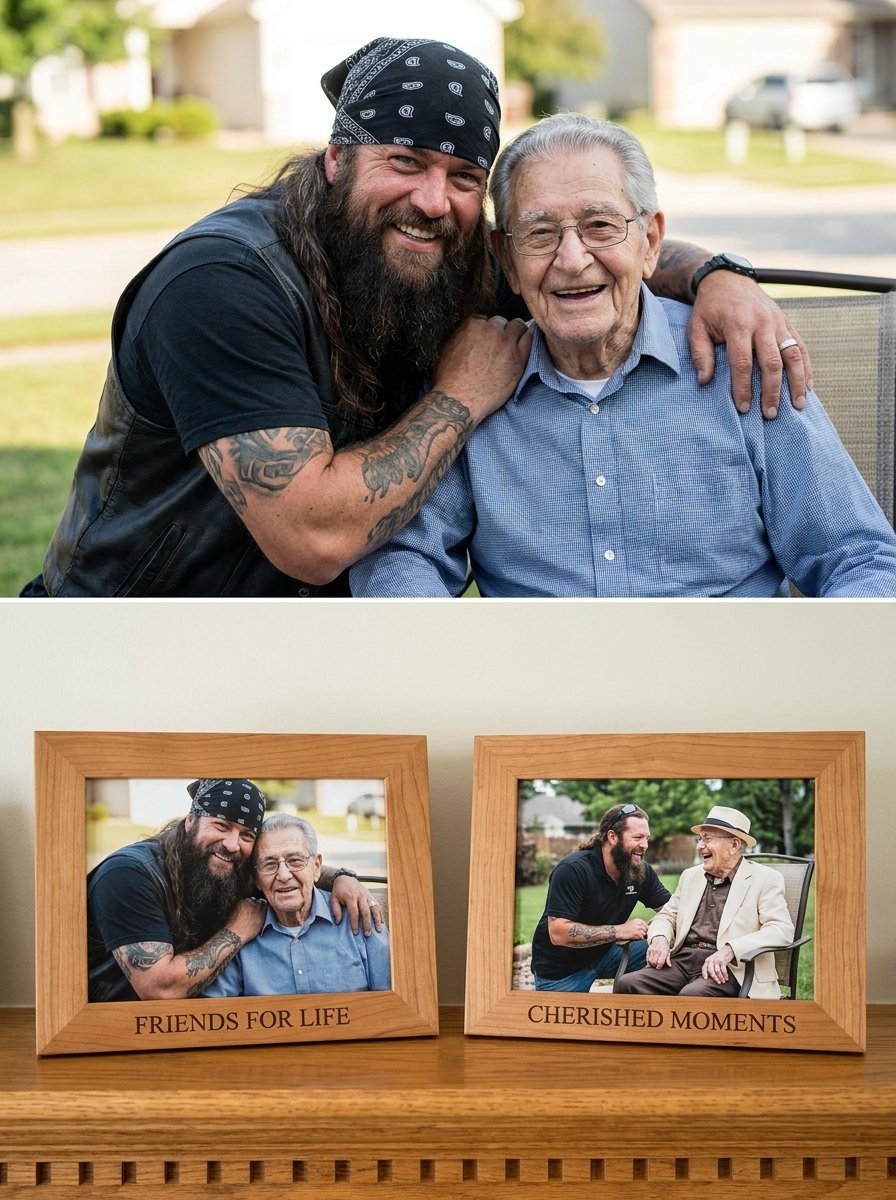
The last Saturday I spent with Arthur didn’t feel important.
If someone had told me it would be the final one, I probably would have stayed all day.
Instead, it unfolded like every other weekend we’d shared for more than a decade.
I picked up his groceries.
Emily packed fresh blueberry muffins before we left.
Noah insisted on bringing Arthur a drawing he’d made in kindergarten.
Three stick figures stood beneath an enormous orange sun.
One was labeled Dad.
One was Me.
The tallest one, wearing what looked like a cowboy hat, was labeled Grandpa Art.
Arthur laughed until tears formed in the corners of his eyes.
“I don’t own a hat like that.”
Noah shrugged.
“You should.”
Arthur carefully placed the picture on his refrigerator with two magnets shaped like trains.
“There.”
“It deserves the best spot in the house.”
While Emily washed dishes, I replaced a loose porch railing that had started wobbling.
Arthur stood nearby pretending to supervise.
“You know,” he said, “I could’ve fixed that myself.”
“You’ve been saying that for eleven years.”
“And one day I’ll prove it.”
“I hope you do.”
When I finished tightening the last bolt, he surprised me by resting a hand on my shoulder.
“Daniel.”
“Yeah?”
“Thank you.”
“For what?”
“For never making me feel like a burden.”
I frowned.
“You never were.”
“I’ve needed more help every year.”
“So?”
“So most people disappear when helping becomes inconvenient.”
I looked at him.
“I was never most people.”
A slow smile crossed his weathered face.
“No.”
“You never were.”
Before we left, he hugged Noah.
He hugged Emily.
Then he hugged me longer than usual.
“See you next Saturday,” I said.
Arthur nodded.
“I’ll put the coffee on.”
Seven mornings later, something felt wrong before I even reached his house.
The porch light was still glowing.
Arthur never left lights on after sunrise.
Never.
I knocked.
No answer.
I called his name.
Silence.
A knot tightened in my stomach.
Two years earlier, Arthur had insisted I keep a spare key.
“Only for emergencies,” he’d said.
I unlocked the front door.
The house was quiet.
Too quiet.
His coffee pot sat empty.
The newspaper remained folded beside the front steps.
I walked slowly toward the bedroom.
Arthur lay peacefully beneath his blanket.
One hand rested over his chest.
He looked as though he had simply fallen asleep while waiting for morning.
I knew immediately.
Still…
…I called 911.
The paramedics confirmed what my heart already understood.
Arthur Bennett had passed away during the night.
He was eighty-two years old.
The doctor believed his heart had simply… stopped.
Peacefully.
Without pain.
Everyone called it a gentle ending.
To me…
…it felt like losing family.
The funeral took place four days later.
Only a handful of people came.
Emily sat beside me.
Noah quietly placed his drawing inside Arthur’s casket.
“I made him another one,” he whispered.
“I don’t want him to be lonely.”
I couldn’t answer.
My throat refused to cooperate.
Rebecca arrived late.
She spent most of the service checking messages on her phone.
As people slowly left the cemetery, Arthur’s attorney asked me to meet him privately.
He rolled out the old rusted trunk.
“This belongs to you now.”
Before I could ask why…
Rebecca confronted me.
“You manipulated him.”
“You isolated him.”
“You convinced him we didn’t care.”
Her voice echoed across the nearly empty parking lot.
I didn’t argue.
Some people aren’t looking for answers.
They’re looking for someone to blame.
That evening, the trunk sat unopened on our dining room table.
Emily poured two cups of tea.
Neither of us spoke for several minutes.
Finally she asked,
“Are you going to open it?”
“I’m afraid to.”
“Why?”
“What if there’s money?”
She looked confused.
“So?”
“What if everyone believes that’s why I stayed?”
Emily reached across the table and took my hand.
“Daniel.”
“Yes?”
“If you’d wanted money…”
She smiled gently.
“…you would’ve stopped showing up years ago.”
She was right.
I unlocked the rusty latch.
The lid creaked open.
Inside…
There were no gold bars.
No expensive jewelry.
No property deeds.
Instead…
There were hundreds of envelopes.
Each one carefully dated.
Every single Saturday.
Eleven years.
Stacked in perfect order.
Beneath them rested three leather journals.
Several old photographs.
And one small wooden box.
My hands began shaking.
I opened the very first envelope.
October 6
Today a young man picked oranges off a wet parking lot without knowing he was rescuing far more than groceries.
He reminds me of Michael.
Not because they look alike.
Because kindness seems to embarrass them both.
I opened another.
Three years later.
Daniel brought someone named Emily today.
She laughs the same way Margaret used to.
I believe he finally found his way home.
Another.
Several years after Noah was born.
The little boy calls me Grandpa Art.
I pretend to dislike it.
Truthfully… I’ve missed hearing a child laugh inside this house.
Letter after letter…
Saturday after Saturday…
Arthur had written about ordinary mornings.
Coffee.
Football games.
Broken porch lights.
Birthday cakes.
Snowstorms.
Thanksgiving dinners.
Conversations I’d completely forgotten.
To him…
They had mattered enough to preserve forever.
Tears blurred every page.
Emily quietly cried beside me.
Then I opened the wooden box.
Inside was a certificate.
An investment account.
Worth $82,000.
Along with a notarized document explaining Arthur had transferred ownership into an irrevocable trust years earlier.
Separate from his estate.
Separate from the house.
Separate from everything Rebecca expected to inherit.
There was one final envelope.
It simply read:
For Daniel.
My dear friend,
If you’re reading this, then you’ve probably already convinced yourself you shouldn’t accept what’s inside the box.
You’re stubborn enough to argue with a ghost.
So let me save us both some time.
This isn’t payment.
No amount of money could repay eleven years of friendship.
You never stayed because you expected something.
That’s exactly why I wanted you to have it.
Rebecca will inherit my home.
She deserves the chance to make peace with it.
This gift belongs to you.
Use it for someone who feels forgotten.
There are lonely people sitting behind curtains in every neighborhood.
You’ll recognize them.
After all…
You recognized me.
Thank you…
…for proving that ordinary Saturdays can save ordinary lives.
—Arthur
I cried harder than I had at the funeral.
Because now I finally understood.
The trunk had never been about money.
It was about memories.
Proof…
That kindness had been noticed.
Rebecca appeared at my house two days later.
She wasn’t angry this time.
Only exhausted.
“I read the copy of Uncle Arthur’s journal the attorney gave me.”
I nodded.
She stared toward the old oak tree in my yard.
“I didn’t know he felt so alone.”
“You never asked.”
“I know.”
For a long time neither of us spoke.
Finally she whispered,
“Do you think he forgave me?”
I remembered something Arthur had once said.
“People who truly love us rarely stop loving us.
They simply stop waiting for us to become someone different.”
“I think,” I answered softly,
“…he hoped you’d find your way back.”
She wiped away a tear.
“I wish I’d visited more.”
“So do I.”
Three months later she mailed me a photograph.
Arthur’s garden.
Instead of tearing it down to renovate the property…
She had restored every flower bed.
Exactly as he and Margaret had planted them decades earlier.
It took almost a year before I decided what to do with Arthur’s gift.
Then one Saturday morning…
The answer arrived on its own.
Emily looked across the breakfast table.
“What if we keep the tradition going?”
“What do you mean?”
“There must be other Arthurs.”
She was right.
There were.
Widowers.
Retired teachers.
Veterans.
People whose children lived across the country.
People who hadn’t shared coffee with another human being in weeks.
Using Arthur’s gift, we started a small volunteer program.
Every Saturday…
Neighbors delivered groceries.
Fixed leaking faucets.
Changed light bulbs.
Shared coffee.
Played cards.
Mostly…
They stayed.
We called it…
Saturday Table.
Our first visit was to an eighty-year-old widow named Helen.
She greeted us by saying,
“I don’t need any help.”
Then she handed me a shopping list with twenty-three items.
I smiled.
“I figured.”
After carrying the groceries inside, I started toward the door.
Helen cleared her throat.
“You don’t have to stay.”
“I know.”
“My coffee isn’t very good.”
I laughed.
“I survived Arthur Bennett’s coffee for eleven years.”
She looked suspicious.
“It couldn’t have been that bad.”
“Oh…”
I pulled out a chair.
“You’d be surprised.”
For the first time in months…
She laughed.
Before every Saturday visit, I still open one of Arthur’s letters.
There are hundreds left.
I’m in no hurry to finish them.
Because each envelope reminds me of something the world often forgets.
Lives rarely change because of grand speeches.
Sometimes…
They change because someone stops to pick up a few oranges.
Sometimes…
Because someone knocks on the same front door every Saturday.
Week after week.
Year after year.
Arthur once told me that ordinary days become extraordinary when someone chooses not to forget you.
Eleven years later…
I know he was right.