
Chapter 12 – The Woman Inside the Center
The Reed Center locked down within six minutes.
Tasha checked every emergency exit personally. Rachel ordered all staff members into the main conference hall and collected their personal mobile phones. Lila found Hope asleep in the child-care room, curled up peacefully beneath a large painted paper sun.
She lifted her without waking her.
“Nobody touches her,” Lila said, her voice trembling with protective rage.
“Nobody will,” Caleb promised.
He desperately wanted to believe it. Then he looked at the list of twenty-three names and remembered that every failed institution in human history had begun with someone declaring that nobody could be harmed there.
The date recorded beside Hope’s name matched the center’s scheduled annual survivor physical examination. Simone had arranged routine blood work for the following morning. If an insider swapped a single collection vial, Hope’s blood could become the biological basis for an unapproved patent. She had been physically present during Elias’s initial drug response years ago and subsequently exposed to trace chemical residue on his medication bottle. To unethical researchers and conspiracy theorists, she remained infinitely valuable as “the miracle baby,” no matter how forcefully the family rejected the label.
Only six trusted employees had access to the private examination schedule.
One of them was June Parker.
June laughed nervously when Rachel brought her into the interrogation room. Then her eyes darted across the table, realizing no one else was laughing.
“You think I sold Hope?”
“I think someone accessed the calendar using your account,” Rachel said evenly.
June’s expression instantly hardened into stone. “Then someone used me.”
Digital forensics revealed her tablet contained a high-level remote-access Trojan disguised inside a routine medication-training software update. The installer signature belonged directly to Meridian. Someone had been silently monitoring her screen for months.
“I should have noticed,” June whispered, burying her face in her hands.
“That is what they want you to say,” Caleb replied. “Shame makes witnesses quiet.”
The malware had harvested far more than scheduling calendars. It had captured private survivor interview logs, residential addresses, and confidential medical histories. The Reed Center’s sacred promise of safety had been secretly converted into a targeted hit list for Shepherd.
Elias immediately convened an emergency board session. Several corporate directors urged that the data breach be kept strictly confidential until affected families could be notified privately.
“That is how this language begins,” Lila interjected fiercely. “Privately. Carefully. To prevent panic. Then someone decides silence protects everyone.”
The center publicly disclosed the full extent of the breach that afternoon.
The public backlash was swift and furious. Terrified families immediately withdrew their children from ongoing treatment programs. Outside the facility entrance, one distraught mother slapped Elias across the face, screaming that he had built another trap to profit off their pain.
He ordered security not to press charges.
“She trusted our door,” he told the security detail quietly. “We failed to guard it.”
Rachel’s team traced the malware’s command IP to an apartment in Baltimore. Federal agents breached the premises, finding racks of processing servers, counterfeit employee ID badges, and walls plastered with surveillance photos of Reed Center staff. The tenant escaped down a rear fire stair, but an attentive neighbor positively identified his face.
Owen Shaw.
Alive and active.
Shaw had intentionally built backdoors into the Open Door network while secretly engineering a shadow database. Erased patient complaints were never destroyed—they were redirected straight to Meridian, which systematically identified vulnerable children whose symptoms could support highly lucrative private research trials.
“He built the cure and the blind spot,” Lucas said, staring at the system schematics.
The shadow database interface utilized a stylized shepherd’s crook as its primary master icon.
Shaw was Shepherd.
However, decrypted messages revealed that Dr. Cross outranked Shaw. In her internal correspondence, she repeatedly deferred to a shadowy superior she addressed only as Founder.
Elias personally scoured historical Warren board minutes. Meridian’s corporate shell first surfaced fifteen years prior as an IT subcontractor recommended by Arthur Vale—Elias’s closest lifelong friend, and the senior corporate attorney who had drafted the legal dissolution of Warren Medical Systems.
Arthur arrived at the Reed Center before Elias even had a chance to call him.
He was seventy-one years old, gentle-voiced, and walked with an elegant cane crafted from dark polished walnut. He had valiantly defended Elias during Adrian’s public trial, helped establish the independent patient trusts, and personally donated the very first million dollars to build the Reed Center.
“I heard about the breach,” Arthur said, stepping into the office with genuine concern. “Tell me how I can help.”
Caleb stood nearby, watching Arthur warmly embrace Elias.
Then Caleb’s gaze dropped down to the old man’s cane.
Engraved into the silver handle was the precise motif of a shepherd’s crook.
Arthur noticed Caleb staring, and he offered a sad, delicate smile. “My family raised sheep. Owen used our old mark for the database.”
“You knew Shaw?” Rachel asked instantly, stepping forward.
“I hired him.”
Arthur made no attempt to deny founding Meridian. He calmly framed it as a legal insurance mechanism created to preserve vital patient records in the event that Warren Medical Systems collapsed. He claimed Dr. Cross and Shaw had maliciously corrupted his benevolent vision.
“Give us access,” Rachel demanded.
“Gladly.”
He smoothly handed over master passwords, corporate contracts, and a complete ledger of physical server locations. The cooperation was so absolute, so seamless, that Caleb deeply distrusted every second of it.
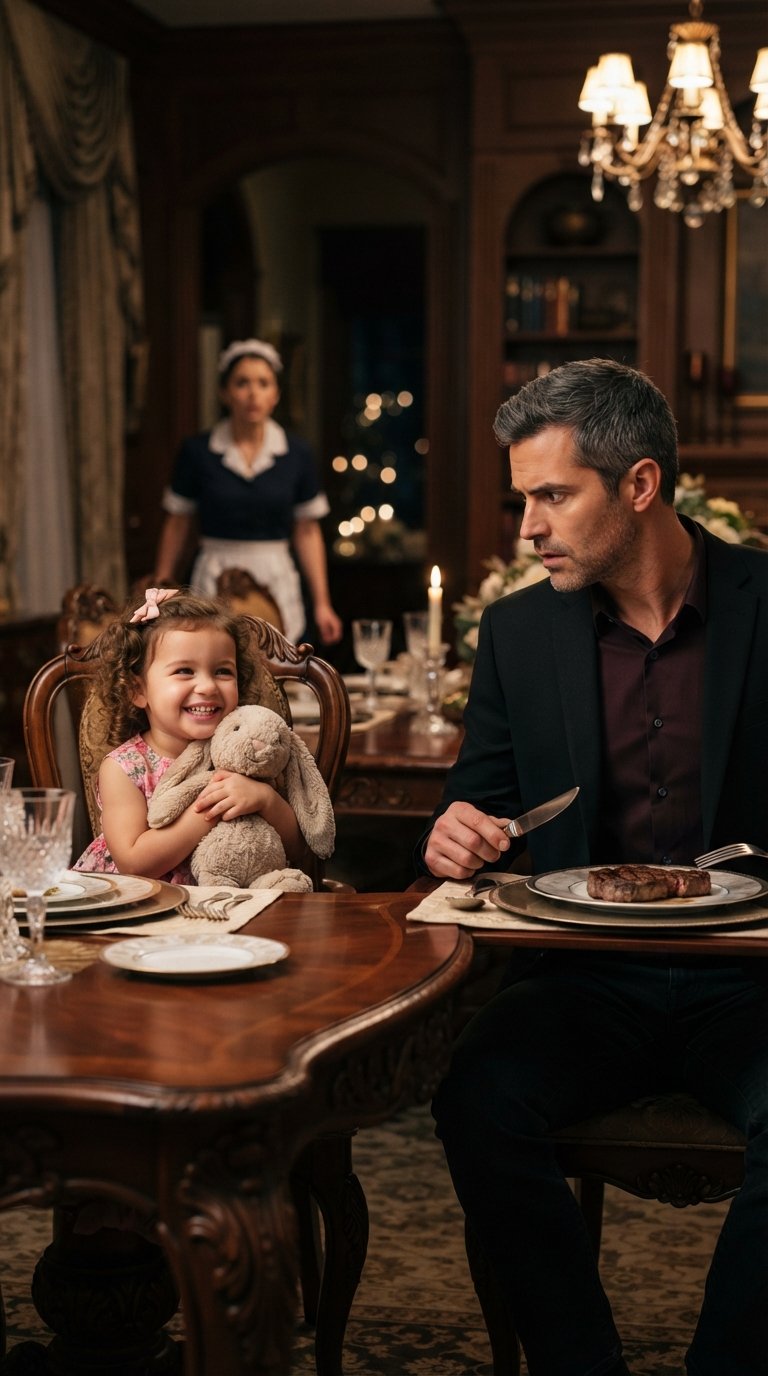
Arthur stayed for dinner that evening. Hope playfully scrambled onto his lap, just as she had done since she was an infant. He pulled a hand-carved wooden lamb from his jacket pocket and placed it in her tiny hands.
“For my favorite miracle,” he said softly.
Lila reached over and firmly took the toy away from Hope.
“We don’t call her that.”
Arthur’s warm smile never faded. “Of course.”
Late that night, a forensic technician dismantled the wooden toy under specialized lab lighting.
Concealed inside the hollow center was a micro-GPS tracking transponder and a spring-loaded needle coated with a fast-acting sedative.
Police tactical units swarmed Arthur’s historic townhouse.
They found the front door wide open and his private study consumed by intense flames.
Scrawled across the wall in dark soot were five words:
YOU NEVER CLOSED MY DOOR.
Arthur’s betrayal cut far deeper than Adrian’s ever had. Elias had spent painful years coming to terms with how he had failed his son, but Arthur had stood directly beside him throughout that agonizing reckoning—offering quiet comfort and appearing to ask for nothing in return. His steady friendship had made moral accountability feel achievable. Now Elias sat in the dark, questioning if a single moment of their shared past had been real.
Caleb found him sitting alone in the center’s courtyard garden long before dawn.
“You can miss him and still stop him,” Caleb said gently.
“What if none of it was friendship?”
“People are not clean categories,” Caleb replied. “Adrian loved you and harmed you. You loved him and failed him. Arthur may have cared about you in the only way he knew—by controlling everything near you.”
“That is not love.”
“No. But it can still hurt like losing love.”
Elias turned his head, studying the mature young man standing before him. “When did you become wiser than I am?”
“Around the time you stopped pretending you were.”
Inside the command center, Rachel uncovered a chilling anomaly: Arthur’s home fire alarm had alerted a private security dispatcher seven minutes before any smoke actually appeared. The emergency call had utilized a synthesized, AI-generated voice profile belonging to Elias Warren. Arthur had quietly built voice-cloning algorithms capable of mimicking authority figures flawlessly.
The terrifying reality hit them like a physical blow. If Arthur could fake Elias’s voice, he could remotely issue complex medical authorizations, override facility security protocols, and fabricate consent without ever stepping foot inside a building.
The lie was no longer merely hidden inside corporate databases.
It could speak with a trusted voice.
That terrifying revelation instantly transformed the investigation from a manhunt for a fugitive into a frantic race against every automated command Arthur had left behind in the network.
Rachel immediately ordered all automated system approvals nationwide suspended. Hospitals across the network temporarily reverted to manual paper verification and mandatory two-person phone confirmations. The sudden shift crippled operational speed and infuriated hospital administrators, but the inconvenience exposed eleven illegal transfers issued by synthetic voices that very night.
Three of those fraudulent orders would have moved children before dawn.
Arthur had banked on systemic efficiency overriding human caution.
For once, caution had arrived first.