Chapter 8 – The Trial of Forty-Two Names
The photograph gave Rachel a direction, not a location.
Digital forensic analysts enhanced the window reflection. Reflected behind Voss and Lucas stood a wall clock bearing a hospital logo, but only half the name was legible: Mercy—North.
Nine regional facilities carried similar names. One, Mercy North Behavioral Center, had formally closed to the public years prior, yet continued drawing federal research grants routed through a Voss foundation.
Federal agents breached the building before dawn.
They found Lucas inside a private third-floor room—fourteen years old, frail, and far smaller than Naomi remembered. He possessed the physical ability to walk short distances, but every door along the corridor was locked from the outside. Facility staff claimed he was an official ward of the research program, though no court had ever sanctioned such a guardianship.
Naomi waited anxiously at County University Hospital while Rachel escorted him in. Mother and son locked eyes through the glass security doors.
Neither moved at first.
Lucas had been manipulated into believing Naomi had abandoned him after the boating accident. Naomi had spent three agonizing years convinced he was dead. Lies of that magnitude did not instantly dissolve the moment a door opened.
Then Lucas caught sight of the faded red sneaker in her hands.
He crossed the lobby with an uneven, hesitant gait, collapsing against her chest.
Naomi held him tightly, unable to speak.
The reunion served as the prosecution’s most compelling evidence, yet remained its most fragile moment. Voss’s defense team immediately argued that Lucas had been safely protected rather than illegally imprisoned, presenting signed consent forms bearing Naomi’s signature.
Naomi recognized the deception instantly. Years earlier, Voss had instructed her to sign blank digital medication receipt screens—a tactic mirror-imaging how Miriam had stolen Khloe Thorne’s signature in another hospital scandal. The technology differed, but the betrayal was identical.
Lucas agreed to testify under one condition: forty-two empty chairs had to be arranged directly behind him in the courtroom.
“Why chairs?” Rachel asked softly.
“Because they talk about us like files,” he replied. “I want the jury to see how much space forty-two children take.”
The judge granted the request.
On the opening day of trial, the forty-two empty chairs lined the entire back wall of the gallery. Each bore a physical name tag from the Bright Horizon registry. Four chairs were draped with white lilies honoring the children confirmed dead.
Celeste Voss arrived in a tailored navy suit, composed and stoic. Adrian sat at the neighboring defense table after prosecutors consolidated key counts of their indictments. Father and son exchanged a single glance across the room.
Elias felt a deep, enduring grief, but grief no longer dictated his choices.
Lila testified first. She detailed the hidden drug regimens, the altered labels, and the Grayhaven records. Defense counsel repeatedly attempted to dismiss her as a bitter former employee.
“You stole drugs from Mr. Warren,” the attorney accused.
“I removed poison from his tray.”
“You had no authorization.”
“The people harming him controlled authorization.”
June Parker took the stand next. Marcus, Daniel, and Aisha followed. The prosecution made no attempt to frame them as pristine or perfect victims. June admitted she had once turned a blind eye to another patient’s cries out of sheer terror of retaliation. Marcus admitted to signing intake forms without reading the fine print. Their unvarnished honesty laid bare the institution’s systemic manipulation, making their testimony far more damaging.
Elias took the stand on the sixth day.
Adrian’s defense attorney displayed corporate emails in which Elias had demanded aggressive trial enrollment and berated executives for missing research deadlines.
“You created the pressure, didn’t you?”
“Yes.”
“You signed the authorization.”
“My digital token was used, but I created a system where my approval was treated as more important than patient consent.”
“So you blame your son for following your culture?”
Elias turned his head, looking directly at Adrian.
“I blame him for kidnapping people and poisoning them. I blame myself for building doors his last name could open. Responsibility is not a pie. His guilt does not require my innocence.”
The response shattered the defense strategy of forcing the jury to pick a single culprit.
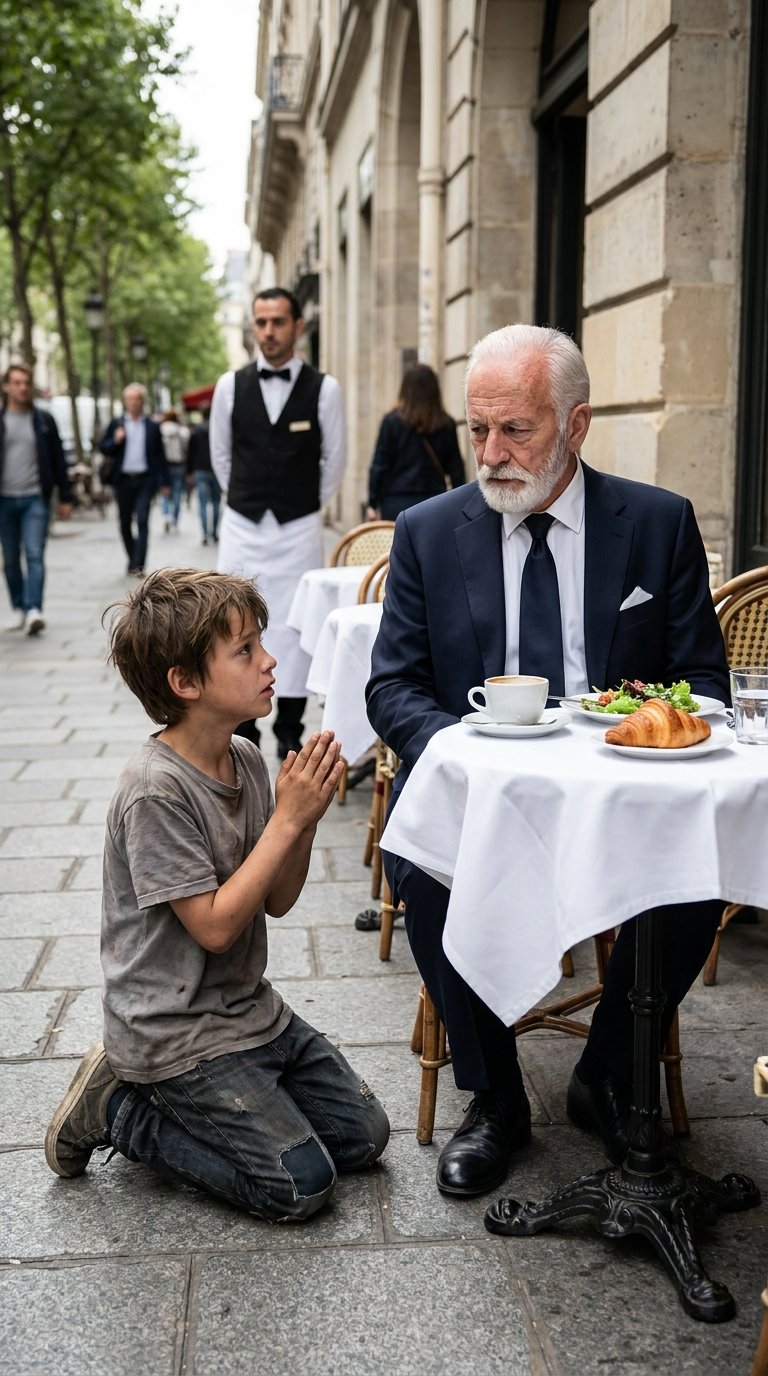
Caleb was not scheduled to take the stand. As a minor, Rachel hoped to shield him from the trial, but after Voss’s attorney asserted to the press that the sidewalk café encounter had been orchestrated by Elias’s publicists, Caleb insisted on speaking.
He described the coinless hunger of those five cold nights, the baby formula thinned with water, and the exact moment he knelt on the pavement beside Elias. He did not paint himself as a hero; he openly admitted he had told the old man Hope could heal him because he desperately needed Elias to listen.
“Was that a lie?” the defense attorney pressed.
“I thought it was true. Then evidence showed me something else.”
“So you were wrong.”
“Yes. Adults should try saying that faster.”
Ripples of laughter swept through the gallery before the judge restored order with her gavel.
Lucas testified last. He recounted how Voss systematically alternated between the nerve-suppression drug and the reversal compound, documenting every loss and recovery of limb movement. He knew the dosing schedules strictly by the color of the nurse’s rubber gloves.
“Why didn’t you escape?” defense counsel asked.
Lucas looked back at the forty-two empty chairs.
“Where would I go? My mother was dead. The papers said Voss owned every decision about me. Every adult who entered my room called the locked door treatment.”
The prosecution submitted the ranger station text logs, Martin’s recorded phone call, Caleb’s camp photograph, and the lab analysis of Lucas’s bloodwork. The destroyed evidence archive no longer mattered; the truth had survived across too many independent hands.
After three weeks, the jury retired for deliberations.
On the second evening of deliberations, Adrian requested a private meeting with Elias.
“Voss will be convicted,” Adrian said through the thick glass partition. “Help me separate my case. I will testify against her.”
“You already had that chance.”
“I am your son.”
“You were my son when you drugged me. You were my son when you took children. Love may explain why this hurts. It does not erase what you chose.”
Adrian slammed both palms against the glass. “Then what was any of it for? Everything you built was going to strangers. I protected our name.”
“A name that requires suffering to survive deserves to end.”
The jury returned the following morning.
Guilty on every primary count.
Voss maintained an unreadable expression until the clerk read the conspiracy conviction linked to the ranger station attack. Adrian slumped forward, lowering his head.
Outside the courthouse, families gathered along the marble steps. News networks heralded the trial as a total victory.
Rachel refused the label.
“A verdict is accountability,” she told reporters. “Victory is what happens when the next child is believed before evidence has to be smuggled in a baby blanket.”
That evening, Elias received an unmarked envelope at his bedside.
Inside was a single Warren Institute security keycard accompanied by a handwritten note in Adrian’s distinct script:
YOU CONVICTED THE PEOPLE. YOU STILL HAVEN’T SHUT DOWN THE MACHINE.
On the back was a list of six active facilities. The first entry was the free community clinic where Jonah had received his very first dose.
It was still operating, treating children.