Chapter 4 – What Hope Really Healed
The gunshot shattered the overhead fixture, showering the dark tunnel with glass.
The sudden flash destroyed Adrian’s tactical advantage.
Rachel’s breach team had navigated through the ancient boiler passage into the river building. An officer had fired only after Adrian pointed his handgun directly toward the kids, taking out the light source and forcing him to recoil into the shadows.
“State police! Drop the weapon!”
Panicking, Adrian grabbed Lila, pinning her arms behind her as a human shield. His two paid guards immediately raised their hands. They were hired to secure facility doors, not lay down their lives for an executive burning evidence.
“Let us leave,” Adrian screamed, his voice wild, “or she dies.”
Lila shifted her eyes directly to Caleb. She ignored the barrel pressed against her, ignoring Adrian entirely.
“Take them through the door,” she said steadily.
Caleb stood frozen on the flooded concrete.
“Mom—”
“You already did the brave part. Now do the living part.”
Rachel kept Adrian talking, drawing his focus while officers escorted the rescued patients past his peripheral vision. Maya carried baby Hope high in her arms. Caleb and the elderly woman wrapped Jonah’s arms over their shoulders. The moment the children crossed the threshold into safe hands, Lila drove her heel violently onto Adrian’s foot and dropped her entire weight.
Rachel closed the gap before he could recover his balance.
Adrian was disarmed, tackled, and cuffed.
No second shot was fired.
Within hours, emergency medical vehicles swarmed the Grayhaven yard. Forensic teams uncovered seventeen patients held under fake names, many subjected to unapproved experimental drugs. Some suffered real neurological conditions. Others had been intentionally weakened until their symptoms aligned with trial profiles engineered to lure venture investors.
Families arrived throughout the cold night holding old photographs and unanswered letters. June Parker’s nephew dropped to his knees when he saw her alive. Marcus’s mother had been told her son abandoned her after stealing clinic funds; she produced every text message he sent right before he vanished.
Rachel refused to issue a press release until every patient was identified by name. She knew how massive corporations hide behind statistics.
“Seventeen is evidence,” she stated firmly. “Their names are accountability.”
At Grayhaven, staff members turned on each other instantly. A technician surrendered redundant drives hidden inside an oxygen cabinet. A guard provided duty logs proving Adrian personally oversaw dosing schedules. The assistant tried burning records in a trash barrel, but the automated sprinkler system preserved enough pages to rebuild the experimental logs.
The truth survived because terrified people preserved separate pieces.
Jonah received medical care right away. His recent dose was low, and motor function returned within days. Hope was healthy. Maya refused to put the infant down until Lila promised three separate times that nobody would take her again.
At County University, Elias asked to see the family.
Caleb walked in first.
He did not kneel.
Elias noticed, deeply relieved.
“Your mother is safe,” he said softly. “Your brother is improving.”
“I know.”
“I laughed at you.”
Caleb looked toward the wheelchair. “You thought I wanted money.”
“I thought desperation made you foolish. The truth is that comfort made me blind.”
“Are you going to walk?”
Elias considered the question. “I may. Perhaps with braces. Perhaps only a few steps. I will need the chair for a long time, maybe always.”
Caleb nodded slowly. “Then Hope didn’t heal you.”
“No. She reminded my doctor to test what everyone had stopped testing.”
Lila stepped in holding the baby. Elias struggled to look her in the eye.
“You tried to warn me.”
“You were drugged and isolated.”
“Before that. I allowed Adrian to route every complaint through his office because it was efficient. I made it easy for him to silence people whose names never reached my desk.”
Lila gently set Hope into his lap.
“Then change the desk.”
The baby touched his hand and yawned.
No flash of light occurred.
Yet it remained the most profound moment of his life.
Adrian and his inner circle were indicted for kidnapping, medical fraud, human experimentation, assault, and conspiracy. Elias’s temporary guardianship was revoked. A court advocate reviewed his decisions until doctors confirmed he could manage his affairs without drugs.
The initial hearing took place inside Elias’s hospital room. Adrian’s defense attorney argued that a confused, elderly man had been manipulated by homeless children and a disgruntled ex-employee.
Caleb heard the argument from the corridor and asked Rachel if being homeless made evidence less valid.
“No,” she replied. “It often makes powerful people assume nobody will preserve it.”
The judge listened to Lila’s recording, evaluated the toxicology results, and inspected Elias’s cloned digital signatures. She stripped Adrian’s authority before lunch.
Elias expected satisfaction, but felt grief instead. Adrian was once a curious child following him through laboratories, asking why machines hummed. Ambition had twisted him. Elias could mourn that boy without protecting the criminal he became.
Elias raised no objections.
“If power cannot survive oversight,” he informed the judge, “it should not survive at all.”
He removed every family member from operational leadership across the medical network, including himself. An independent board of doctors, patients, nurses, disability advocates, and community leaders assumed control. Grayhaven was demolished.
The new board’s inaugural meeting included June, Marcus, Lila, and three parents whose children had received false medication. Elias sat as a witness, not chairman. His head-of-the-table seat had been removed.
The change stung initially.
Then June asked why low-income clinics lacked independent oversight. Marcus asked why consent forms were written only in complex legalese. Lila demanded a reporting line bypassing regional managers.
These were questions Elias’s old board avoided because everyone benefited from assuming the system worked.
Elias took notes quietly.
Losing control felt like real progress.
The company established a restitution fund, though Elias refused to call it charity.
“Charity is something freely given,” he said. “This money belongs to people we harmed.”
Lila testified about the illegal trials. Offered her nursing position back with a promotion, she declined.
“I will work where speaking does not require permission from the person being accused.”
She joined the state’s patient-safety office instead.
The children moved into an apartment near her office. Caleb returned to school, though he struggled sitting with his back to a door. Jonah attended occupational therapy. Maya hid bread under her mattress for months; Lila never scolded her, replacing stale slices with fresh ones each morning until Maya stopped hiding food.
Hope walked before Elias did.
At eleven months, she took three steps across Lila’s rug and fell into Caleb’s arms. Everyone cheered. Elias watched via video call from rehabilitation.
His own recovery was slow.
On day one, Elias demanded the physical therapist increase his workout intensity. She refused.
“You ran companies by forcing timelines,” she noted. “Nerves do not answer quarterly targets.”
He disliked her instantly and requested her for every session.
She taught him to notice sensations without judging them: warmth in his calf, pressure beneath his heel, a muscle twitch that appeared twice and disappeared for a week.
Caleb visited after school, doing homework beside the mat. Neither mentioned the café until Elias managed his first supported stand.
“You look taller,” Caleb remarked.
“You did too, once you stopped kneeling.”
Both understood the meaning behind the humor.
Withdrawal revealed neural activity, but eighteen months of bed rest had withered his muscles. Therapy began with standing frames and tiny exercises.
Some days his foot moved; some days it stayed still.
He learned not to tie his self-worth to movement.
Dr. Simone Grant corrected journalists describing his wheelchair as something he was “confined to.”
“The chair gives him mobility,” she stated. “The crime was not the chair. The crime was stealing his choices and falsifying his care.”
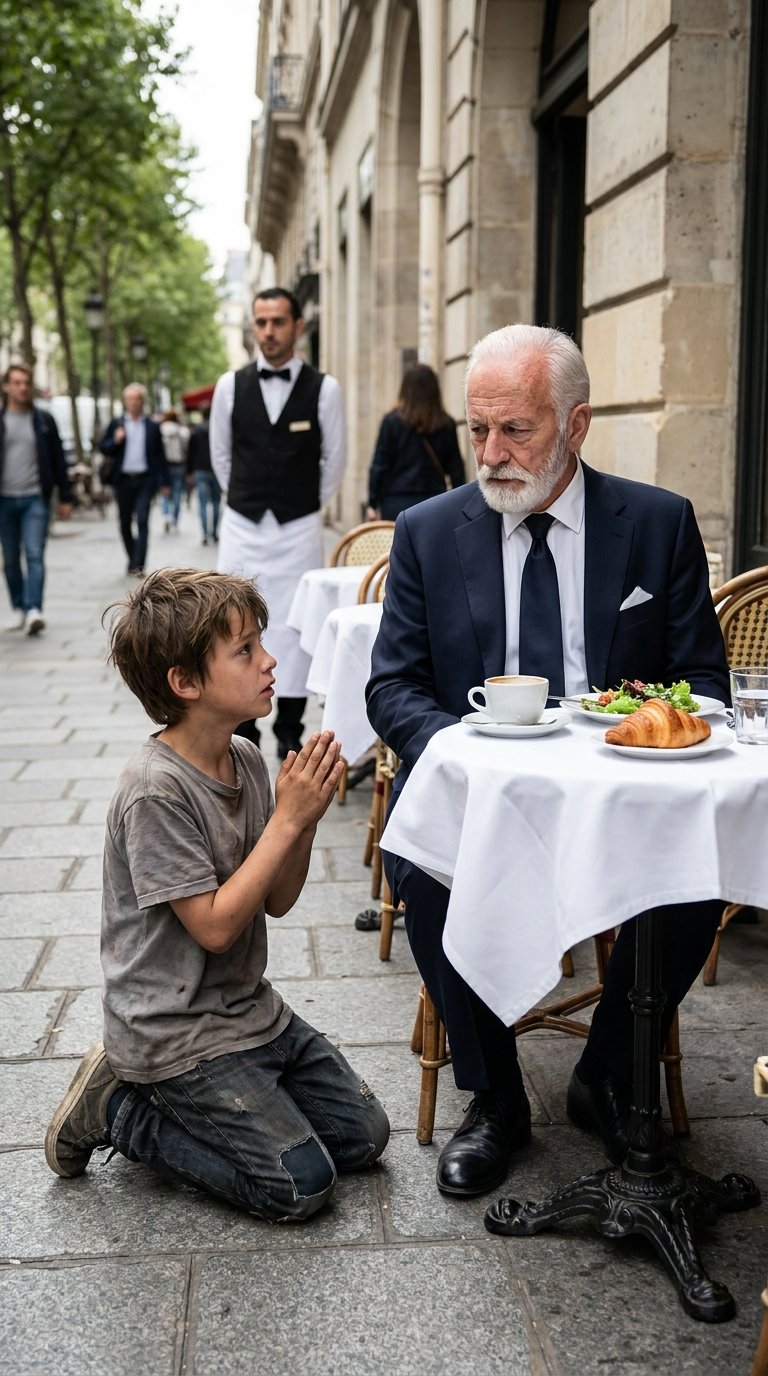
Six months after Grayhaven, Elias returned to the sidewalk café.
The manager reserved the same table, but Elias requested a larger one. Lila arrived with all four children, warmly dressed. Caleb ordered before checking prices, though he still divided the bread automatically.
Elias placed his hands on a walker beside his wheelchair.
“You don’t have to prove anything,” Caleb said gently.
“I know. That is why I want to try.”
Simone stood nearby. With leg braces locked, Elias pushed upward. His arms bore most of the weight. His left foot moved first.
His right dragged forward half an inch.
One step.
Uneven. Assisted. Real.
He sat down before exhaustion took over.
The café patrons clapped. Elias held up a hand.
“Please save that for the children,” he called out. “They crossed a city carrying the truth while adults with offices buried it.”
Caleb blushed. Maya climbed onto her chair and bowed.
Laughter filled the café.
Hope reached from Lila’s lap and touched Elias’s knee.
His foot did not twitch this time.
He smiled anyway.
The baby had never carried magic in her hands. She carried interruption. Her touch interrupted a lie. Her spilled bottle exposed a label. Her presence pushed desperate kids toward a man who had stopped asking whether his medical diagnosis served someone else.
Hope had not healed Elias’s legs.
She had helped return his life to him.
And that was miracle enough.